

Practical structure for Canadian small business owners.
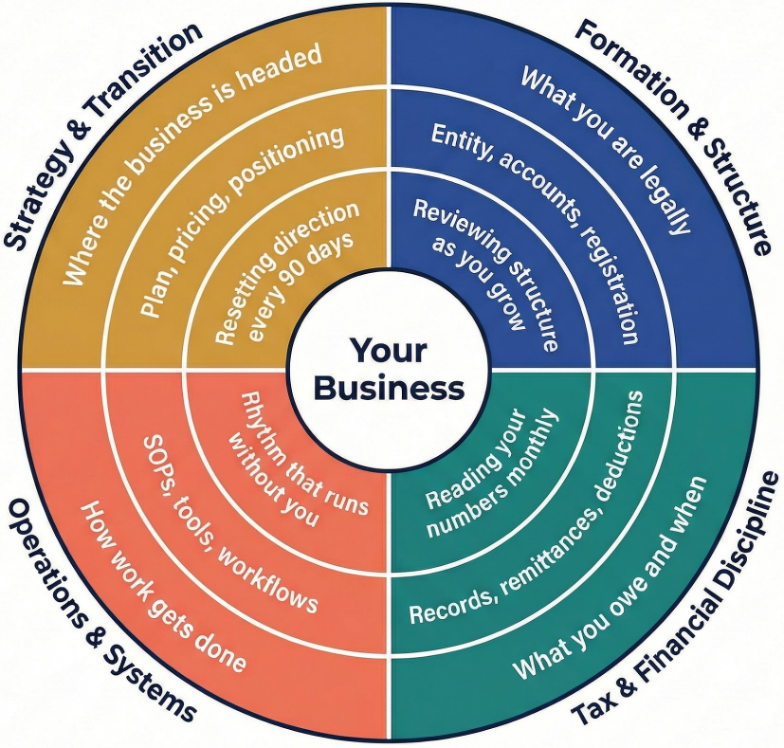
Built to Thrive© was created to help Canadian small business owners understand, organize, and strengthen the core responsibilities that shape a business over time.
Most owners do not struggle because they lack effort. They are usually dealing with scattered responsibilities: setup decisions in one place, records somewhere else, tax handled later, operations running on memory, and planning pushed aside until pressure builds.
Built to Thrive exists to make that responsibility easier to see.
The goal is simple: Clarity reduces friction. Structure reduces stress.
- Formation & Structure
- Tax & Financial Discipline
- Operations & Systems
- Strategy & Transition.
Why Built to Thrive Exists
Many small businesses begin with action before structure.
An owner registers a business, opens an account, starts taking on work, sends invoices, buys tools, collects payments, and figures things out along the way. That is normal. But over time, small gaps can compound.
Records become inconsistent. Tax obligations become unclear. Personal and business activity get mixed. Customer work depends too much on memory. Year-end becomes stressful. Planning happens only when pressure builds.
Built to Thrive exists to help owners organize those responsibilities before they become expensive, overwhelming, or difficult to fix. It is not designed to make business more complicated. It is designed to make the business easier to understand.
The video provides a short overview of why Built to Thrive exists and how the Guides, Tools, Explainers, and Books are meant to work together.
Built for Canadian Small Business Owners
Built to Thrive is designed for Canadian small business owners who want practical clarity, not generic business advice. It is especially useful for:
- sole proprietors
- freelancers
- consultants
- incorporated owner-operators
- side-business owners
- early-stage business owners
- owners who want to understand their business more clearly
You do not need to become an accountant, lawyer, operations consultant, or strategist to run a stronger business. But you do need enough structure to understand what is happening, what needs attention, and what to do next.
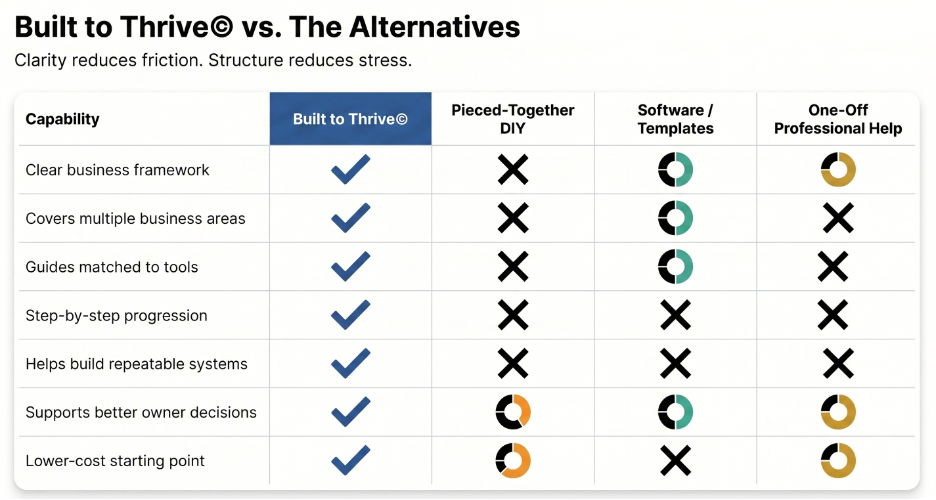
COMPARISON
A clearer starting point than piecing it together yourself
What Built to Thrive Is Not
Built to Thrive is educational. It does not replace legal, tax, accounting, payroll, investment, or financial advice. The purpose is to help owners become better prepared for those conversations.
When you understand the basics, you can keep better records, ask better questions, use professional advice more effectively, and make decisions with less guesswork.
Start Where You Are
A stronger business is not built by fixing everything at once. Start with the area creating the most friction right now.
- If setup is unclear, start with Formation & Structure.
- If records, expenses, GST/HST, or year-end are stressful, start with Tax & Financial Discipline.
- If daily work depends too much on memory, start with Operations & Systems.
- If the business is busy but directionless, start with Strategy & Transition.
Start where you are. Build from there.