
Run your Canadian small business with less uncertainty.
Clarity reduces friction. Structure reduces stress
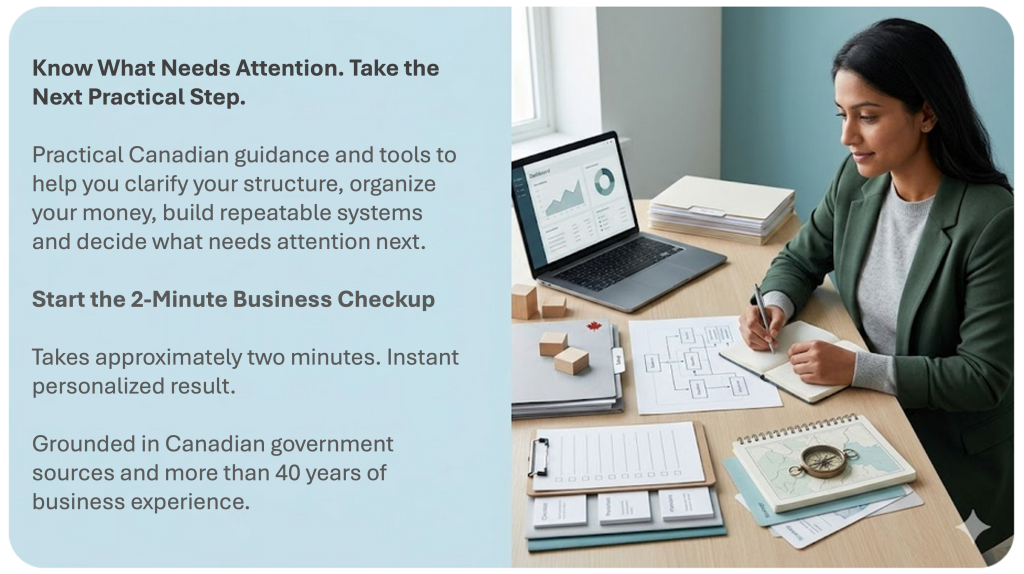
Practical guidance and tools to help you clarify your structure, organize your money, build repeatable systems and decide what needs attention next.
Informed by 40+ years of business leadership and Canadian sources.
Not Sure What Your Business Needs Next?
Takes 2 minutes. Review four areas of your business and receive an instant, personalized starting point.
Find Your Starting Point
Choose the specific situation that matches the work in front of you.
Unsure whether you’re set up properly?
Clarify your structure, registrations, accounts and business boundaries.
Stressed about records, taxes, or money?
Organize your records, GST/HST, cash and year-end responsibilities.
Tired of keeping everything in your head?
Build repeatable routines that do not depend entirely on you.
Unsure what the business needs next?
Examine pricing, capacity, direction and changing priorities.
You don’t need to work through every area, or in order. Pick the one creating the most pressure right now.
A System, Not a Library
Most business advice is either too generic to use or too overwhelming to follow. Built to Thrive organizes each topic through the same three-layer learning path. Start with the layer that matches what you need now.
🟢 Awareness — Recognize what is happening, why it matters and what may need attention. (Free)
🔵 Practice — Put a clear routine, habit or process into use. (Free to Practice / Paid to Master)
🟡 Maturity — Review what is in place, identify gaps and prepare for growth or change. (Paid)
Key Benefit: You do not have to begin at Awareness. If you already understand the issue, start with Practice or Maturity.
See How the Built to Thrive Learning Path Works
Every resource is intended to strengthen one or more of five business outcomes: clarity, control, organization, adaptability and value over time.
Explore the Five Business Outcomes of a Stronger Business
See how the whole system fits together
Explore the four domains, three development layers and five stronger-business outcomes.
Popular Starting Points
Choose a practical resource for the work in front of you.
Sole Proprietor Starter Toolkit
Organize records, understand expenses, and name files consistently.
Corporation Starter Toolkit
Separate accounts, establish a 90-day money routine, and understand shareholder rules.
The Tax-Ready Small Business in Canada
Build dependable record-keeping, GST/HST awareness and year-end habits.
$9.99