
The Four Domains of a Stronger Business
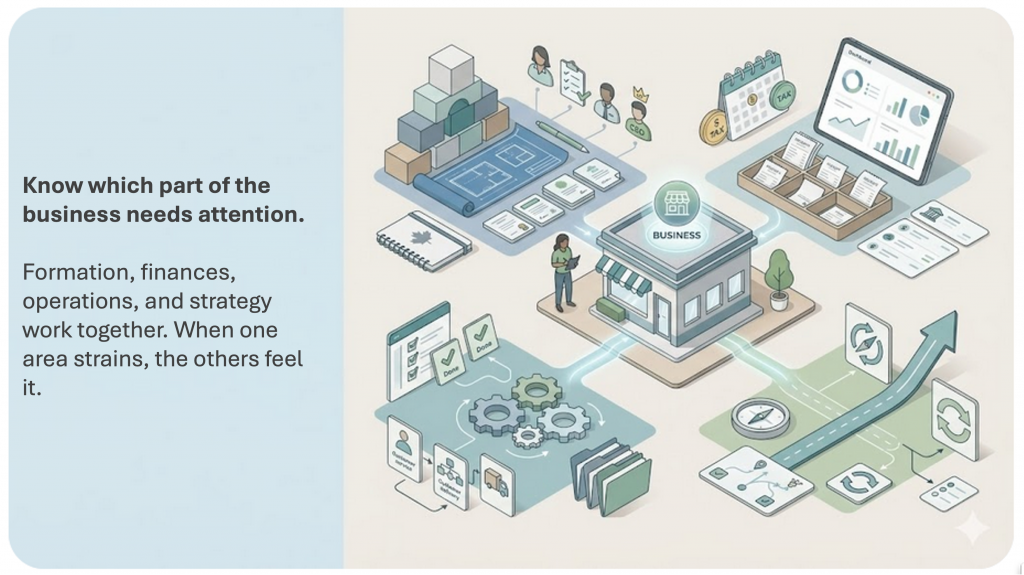
Built to Thrive organizes the work of running a small business into four connected domains: how the business is set up, how its money is managed, how repeated work gets done and how decisions and change are handled.
Start with the area creating the most uncertainty, friction, or pressure. The domains are connected, but they are not stages and do not need to be completed in order.
What Does Your Business Need Help With?
| Domain | Start here when… | It helps you… |
|---|---|---|
| Formation & Structure | Setup, ownership, responsibilities, registrations or the boundary between the business and owner are unclear. | Clarify how the business is structured, who is responsible for what and whether the current structure still fits. |
| Tax & Financial Discipline | Records, expenses, GST/HST, tax planning, owner transactions or year-end preparation are difficult to manage. | Build stronger financial routines, improve visibility and prepare earlier for tax and year-end responsibilities. |
| Operations & Systems | Repeated work is inconsistent, depends on memory or relies too heavily on the owner. | Create clearer routines, workflows, documentation and handoffs. |
| Strategy & Transition | Direction, pricing, capacity, growth, owner role or an important change requires a decision. | Clarify priorities, compare options, and prepare for change. |
Not Sure Where to Start?
The Business Checkup reviews all four domains and identifies the area that may deserve attention first.
Takes 2 minutes • Instant personalized result
See the Whole Business
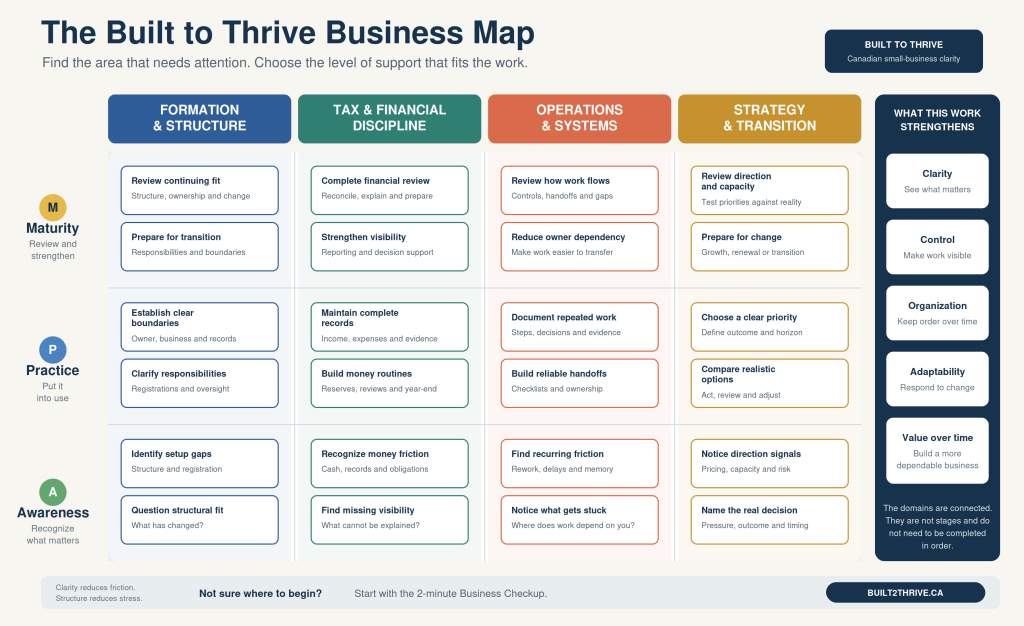
The Built to Thrive Business Map shows how the four domains develop through Awareness, Practice and Maturity. Use it to identify the work that deserves attention now. The domains are connected, but they are not stages and do not need to be completed in order.
How the Domains Work Together
A problem may appear in one domain while its cause or consequences lie in another. Seeing these connections can help you address the underlying issue rather than only its most visible symptom.
| What the owner notices | Possible connection |
|---|---|
| Personal and business money are mixed | Formation & Structure may be weakening Tax & Financial Discipline |
| Work cannot be handed off | Operations & Systems may be limiting Strategy & Transition |
| Growth is increasing stress rather than capacity | Strategy decisions may have outpaced operating systems |
| Financial records are current but decisions remain unclear | Financial information may not yet be connected to strategy |
What This Work Is Intended to Strengthen
The four domains describe where you work on the business. The five outcomes describe what that work is intended to strengthen: Clarity, Control, Organization, Adaptability and Value Over Time.
Work in one domain can strengthen several outcomes. Better financial records, for example, may improve control, clarify decisions and make the business easier to manage through change.
Explore the Five Business Outcomes of a Stronger Business
How Each Domain Develops
Each domain develops through the same practical progression:
🟢 Awareness: Recognize what is happening, understand why it matters and identify what may need attention.
🔵 Practice: Put a clearer habit, record, routine or process into use.
🟡 Maturity: Review what is already in place, identify gaps and strengthen it as the business changes.
These are levels of business development, not steps that must be completed in order. They also do not determine whether every resource is free or paid. Each resource page explains its access requirements.
Clarity reduces friction. Structure reduces stress.
Choose the Resource That Fits the Work
Once you know which domain needs attention, choose the kind of support that matches what you are trying to do.
| If you need to… | Start with… |
|---|---|
| Identify what may be wrong | The Business Checkup or an Awareness guide |
| Understand a specific responsibility or problem | A free guide or article |
| Put a practical method into use | A checklist, worksheet, calculator or starter toolkit |
| Work through one defined issue | A focused book, mini-book or standalone tool |
| Build a more connected working system | A domain toolkit or Command Centre |
| Determine the correct legal, tax or accounting treatment | The appropriate qualified professional or government authority |
See the Complete Framework
Download the Printable Overview
Keep the four domains and their connections in one concise reference.
Watch the system overview
See how the domains connect and how to identify which part of the business may need attention next.