
The Canadian Sole Proprietor’s Field Guide
Build the System as You Go
A practical Canadian guide to recording transactions once, keeping the month current, reading the financial picture, making bounded cash decisions and preparing a cleaner year-end handoff.
Start with the records you already have. Add one useful capability at a time. Understand the system well enough to build it yourself, maintain it properly or move to bookkeeping software with a clearer setup.
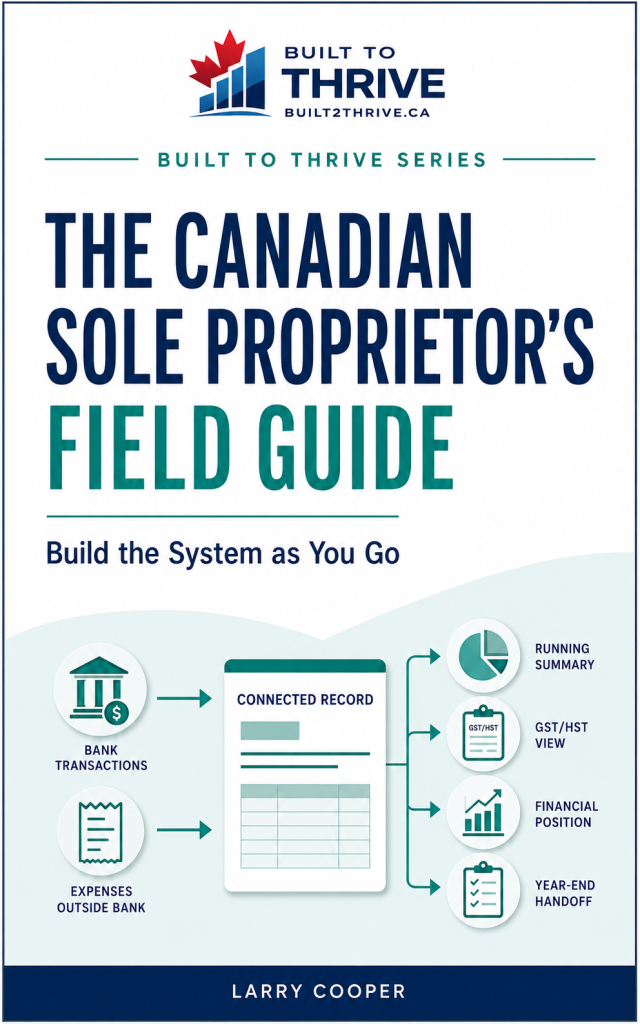
Get the book
The Canadian Sole Proprietor’s Field Guide is available as an eBook from participating retailers.
What Do I Actually Need to Keep Track Of?
A financial system does not need to begin with accounting software.
Many sole proprietors need only a dependable way to capture what happened and reuse the same facts. The difficulty begins when bank transactions, personally paid expenses, owner activity, GST/HST and unresolved items are recorded in different places or not recorded at all.
This field guide shows you how to create one connected record that can answer practical questions throughout the year:
- What information should be organized for a bookkeeper, accountant or tax professional?
- What did the business earn and spend?
- Does the bank record agree with the statement?
- Which movements belong to the owner rather than business performance?
- What GST/HST-related amounts are currently visible in the records?
- What remains unresolved before the month or year can be considered complete?
- What do the current records support when you are considering a cash decision?
Build it once. Reuse the same facts.
The book begins with two input records: Bank Transactions and Expenses Outside the Bank. Each later chapter adds a calculated view, control or decision record without asking you to enter the same transaction again.
| Stage | What you add | What becomes possible |
| Build | Bank transactions, expenses outside the bank and the full facts behind net movements | Capture each transaction once and explain what actually happened. |
| Maintain | Open items, reconciliation, owner activity and GST/HST tracking | Complete the month while keeping missing evidence and unresolved treatment visible. |
| Use | Performance, cash, financial-position and decision views | Read the current picture and record a bounded cash decision. |
| Complete | Year-end review, handoff summary and system-fit review | Prepare organized information and decide what the system needs next. |
THE CENTRAL RULE: Each transaction has one home. Related events share a reference. Calculated views reuse the recorded facts. Missing information remains visible.
What you will learn to build
- A system-fit review for deciding whether to improve the current method or move to a more capable tool.
- A bank-transaction record that follows the order used on bank and credit-card statements.
- A separate record for business costs paid through personal cards, business credit cards, cash or other non-bank routes.
- A running summary and month-completion check.
- Owner-activity and GST/HST tracking views.
- Performance, cash and working financial-position views.
- A cash decision record that preserves the facts, assumptions, outcome and review trigger.
- A year-end adjustment register and professional handoff summary.
Who this book is for
This book is designed for Canadian sole proprietors who:
- maintain some or all of their own financial records;
- want a workable system without beginning with complex accounting software;
- use bank accounts, credit cards, processors, platforms or personal payment routes for business activity;
- need to understand the difference between business performance, cash, owner activity and tax-related amounts;
- want to arrive at month-end and year-end with fewer unexplained transactions and better-organized questions; or
- expect to use bookkeeping software later and want to understand the accounts, categories and reports that must be set up properly.
BOOK BOUNDARY: The book is complete on its own. No workbook purchase is required to build or use the method.
Choose how you want to implement the system
The book teaches the complete method. Choose whether to build it yourself or use an optional workbook implementation.
Option 1: Build it yourself with the book
Use the simulated sheets, field maps, starter formulas, controlled labels and checklists in the book to create your own record in Excel, Google Sheets, a notebook or another tool you can maintain.
The Canadian Sole Proprietor’s Field Guide is available as an eBook from participating retailers.
Option 2: Sole Proprietor Daily Tracker
The essential connected workbook, already built.
Use the Daily Tracker when you want the core system from the book without constructing the sheets and formulas yourself.
- Bank Transactions and Expenses Outside the Bank input sheets
- running summary and bank-reconciliation controls
- owner-activity and GST/HST tracking views
- performance view and cash decision record
- year-end adjustments and handoff summary
- built-in categories, status labels, formulas and review checks
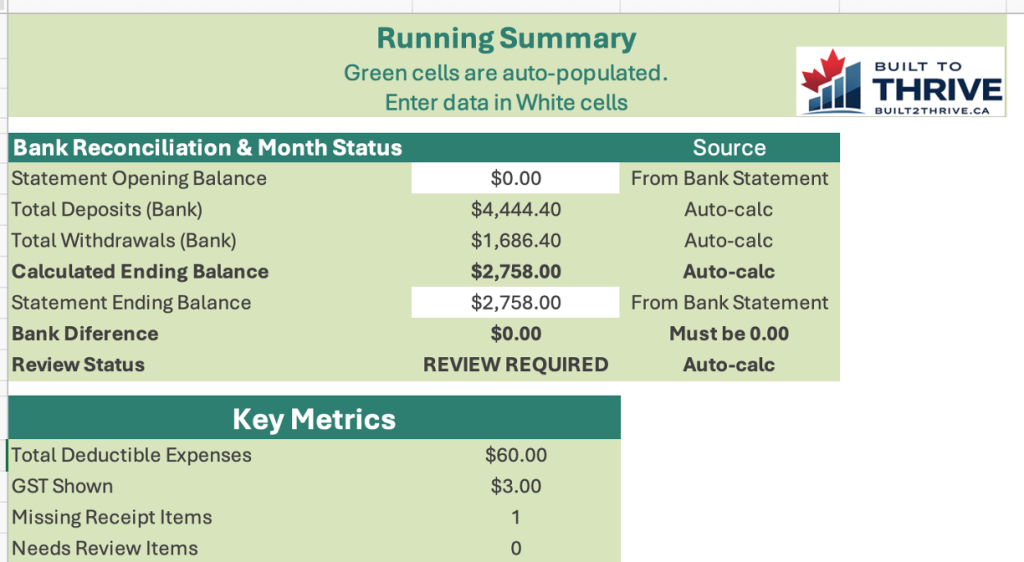
Best fit: You want the essential routine already constructed and do not need the Command Centre’s expanded management and year-end components.
Option 3: Sole Proprietor Command Centre
The fuller management and year-end workbook.
Use the Command Centre when you want the core transaction system plus additional records, management views and preparation support in one connected Excel workbook.
- all core Bank Transactions and Expenses Outside the Bank records
- invoice and accounts-receivable tracking
- journal-entry and capital-asset registers
- home-office and vehicle mixed-use estimation for review
- business-health dashboard, performance view, income statement and financial position
- GST/HST tracking plus a planning comparison for review
- owner activity, cash decision record and accountant handoff summary
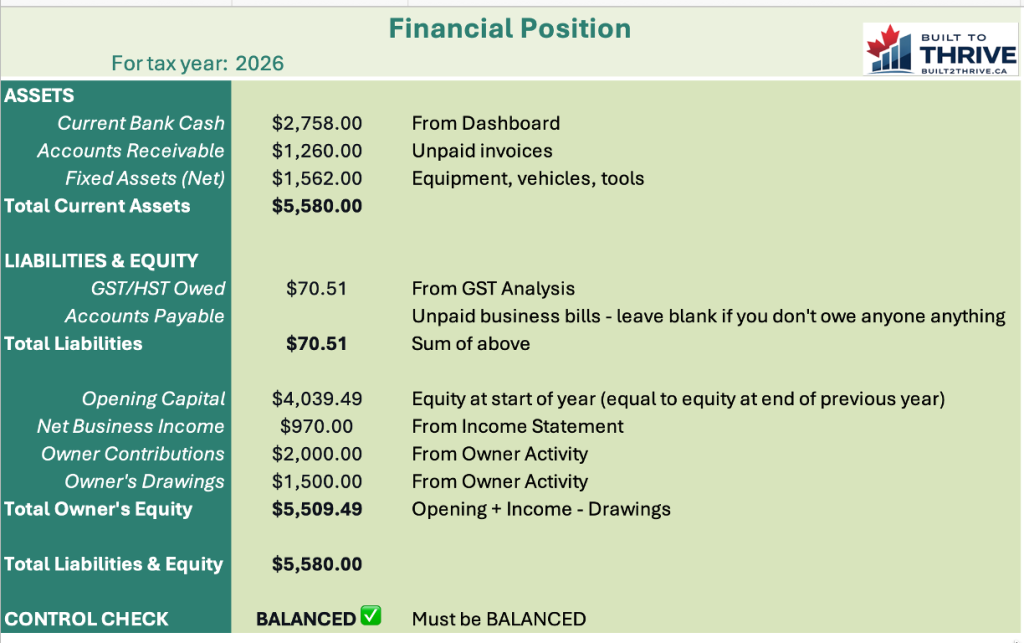
Best fit: You want a more complete internal management view and expect to maintain the additional records consistently.
Which option fits?
| Need | Book | Daily Tracker | Command Centre |
| Learn the method and build your own system | Yes | Reference | Reference |
| Bank and outside-bank transaction inputs | Shows how | Included | Included |
| Running summary and reconciliation | Shows how | Included | Expanded to include Business Health Metrics and Strategic Outlook |
| Owner activity and GST/HST tracking | Shows how | Included | Expanded to include analysis of regular vs. quick method |
| Performance and cash decision views | Shows how | Included | Included |
| Invoice and accounts-receivable register | Not required | Not included | Included |
| Capital assets and mixed-use estimations for Home and Vehicle use | Explains boundaries | Not included | Included |
| Income statement and financial position | Shows working views | Limited | Expanded to include Liabilities and Equity |
| Year-end adjustment and handoff support | Shows how | Included | Included |
The book and workbooks do different jobs
The book explains the structure, the transaction logic, the management questions and the boundaries that remain when professional judgment is required. The workbooks reduce implementation effort by providing prepared fields, formulas and views.
Neither workbook determines deductibility, input tax credit eligibility, mixed-use treatment, capital treatment, Quick Method eligibility, filed tax amounts or whether a cash withdrawal is appropriate for a particular owner. They organize the available facts and make the questions easier to see.
About the Author
Larry Cooper has spent more than 40 years in project and program leadership across public and private sector organizations. In 1997, he started his own consulting business, and has run other small businesses since — including a boutique corporate education firm. Larry is not a Chartered Professional Accountant (CPA), lawyer, bookkeeper, or tax practitioner. He writes as an experienced business owner, consultant, and educator.
He created Built to Thrive to help Canadian small-business owners build stronger foundations and participate more effectively in important business and professional discussions.
FAQs
- Do I need either workbook to use the book?
No. The book contains the fields, component maps, starter formulas and procedures needed to build the system yourself. The workbooks are optional built-for-you implementations. - What is the difference between the Daily Tracker and the Command Centre?
The Daily Tracker provides the essential connected transaction, summary, owner, GST/HST, decision and handoff components. The Command Centre adds receivables, capital assets, mixed-use estimates, fuller management statements, GST/HST analysis and a broader dashboard. - Are these tax-filing workbooks?
No. They support recordkeeping, internal review, planning and professional handoff. They do not prepare or submit a tax return or GST/HST return. - Is this only for GST/HST-registered businesses?
No. GST/HST-registered owners will use more of the tax-tracking material, but the recordkeeping, monthly review and year-end preparation methods apply more broadly. - Will this help me prepare information for my bookkeeper or accountant?
Yes. It helps you preserve more complete information, keep unresolved matters visible and prepare a clearer year-end handoff. It does not replace bookkeeping, accounting or tax services, and fact-dependent accounting and tax conclusions may still require qualified professional review. - Is this bookkeeping software?
No. The book teaches a practical record and review system. The optional workbooks implement that system in Excel. If you later move to bookkeeping software, you will still need to understand how transactions, accounts, categories, reconciliations and reports work. - Does the book tell me whether I can withdraw money?
It shows how to record a bounded decision using current cash, protected amounts, commitments, a buffer and stated assumptions. It does not determine that a withdrawal is appropriate for every owner or circumstance.