
That Money Already Has a Job
A Canadian Sole Proprietor’s Guide to GST/HST, Income-Tax Reserves, Business Commitments, and Owner-Available Cash
Before moving money to yourself, identify what the cash must cover and what is left for the decision.
The bank balance tells you how much cash is in the account. It does not tell you how much is available to withdraw. This focused guide shows you how to give current cash its jobs, test one proposed withdrawal and record a clear decision.
Get the book
That Money Already Has a Job is available as an eBook from participating retailers. Includes access to a blank companion worksheet and a completed example based on Nadia’s decision.
Can I take this money out?
A healthy bank balance does not necessarily mean all of that cash is available to the owner. as it may need to cover several other jobs:
- GST/HST cash identified by the current records;
- an income-tax planning amount or reserve;
- supplier bills, card payments, refunds and other near-term commitments;
- an operating buffer for timing and uncertainty; and
- material unresolved items that could reduce the cash available.
THE BETTER QUESTION: What does this money need to do before I move it?
One book. One decision job.
This is not a full bookkeeping course and it does not make the reader build an elaborate financial system. It is a focused decision guide for the moment when a sole proprietor is considering taking cash from the business.
The approach is deliberately bounded: confirm current cash, identify what needs to stay, calculate what remains, and decide whether to proceed, reduce the withdrawal or wait.
The cash-jobs review
- Set the decision date, next review date and proposed withdrawal.
- Confirm cleared business cash. Trace material or unusual deposits to their supporting records, and exclude receivables, expected deposits, undeposited funds, available credit and personal cash that has not been contributed to the business.
- Identify the tax-related cash being protected, payments due before the next review, operating buffer and unresolved items that could affect cash.
- Subtract those amounts once to calculate the cash remaining for the owner-decision test.
- Compare the proposed withdrawal with the amount remaining.
- Proceed, reduce the withdrawal or wait. Record the decision, reason and next review date or trigger.
What you will learn to avoid
- Letting a future deposit rescue a decision that current cash cannot support.
- Treating revenue, profit, receivables and cash as if they were the same number.
- Counting expected customer payments as current cash.
- Treating tax-related cash being protected as available simply because it remains in the bank.
- Counting the same commitment twice or missing it entirely.
- Recording an owner withdrawal as a business expense.
What is inside the book
The book follows Nadia through one real-world owner decision. Each chapter adds only the information needed to improve that decision.
| Section | Reader outcome |
|---|---|
| Introduction: The Balance Looks Available, Until It Doesn’t | See why cleared cash in the bank does not, by itself, answer an owner-withdrawal question. |
| Chapter 1: The Bank Balance Is Not the Available Amount | Confirm cleared business cash, identify what material deposits represent and separate cash from revenue, profit, receivables and available credit. |
| Chapter 2: Identify What the Cash Already Needs to Do | Identify tax-related cash being protected, payments due before the next review, an operating buffer and unresolved items that could affect cash. |
| Chapter 3: Test the Withdrawal | Calculate what remains, compare it with the proposed withdrawal and choose whether to proceed, reduce the amount or wait. |
| Chapter 4: Keep the Picture Current | Refresh the same four questions when the review date arrives or an important fact changes. |
| When the Simple Check Is Not Enough | Recognize when stronger records, cash-flow forecasting, controls or professional assistance may be needed. |
| Conclusion: Give the Money Its Job Before You Move It | Bring the four-question decision method together through Nadia’s completed decision. |
| Reader Page: Before You Transfer Money, Check This | Apply the method to one proposed owner withdrawal without building another accounting system. |
Who this book is for
This book is designed for Canadian sole proprietors who:
- see cash in the business account but are unsure what can be moved personally;
- want a short decision routine rather than another accounting manual;
- need to keep GST/HST, income-tax planning, upcoming bills and operating cash visible;
- make regular or occasional owner withdrawals;
- want the reasoning behind a cash decision recorded before the transfer; or
- need to know when a simple cash check is no longer enough.
FIT NOTE: The book is written for sole proprietors. Incorporated owner-managers have different legal, payroll, dividend and shareholder-account considerations.
Use the book on its own or use the included companion worksheet
The book explains the complete method and includes a copyable reader page. Readers also receive access to a prepared companion worksheet, with access instructions provided inside the book.
The book
Explains the reasoning, the sequence, the limits and the records needed to make one bounded owner-withdrawal decision. The reader can build the cash-jobs view independently in Excel, Google Sheets, a notebook or an existing bookkeeping workflow.
Included companion: Give the Balance a Job
Book readers receive access to a one-page companion worksheet containing the decision layout used in the guide. It provides space to enter:
- the decision date, next review date, accounts included, proposed withdrawal, purpose and relationship to any regular withdrawal;
- current cleared business cash, GST/HST-protected cash, income-tax-protected cash, known commitments, the operating buffer and material unresolved items;
- the cash remaining for the owner-decision test, the withdrawal tested and the resulting decision margin; and
- the integrity checks, decision, reason, next fact or action, and next review date or trigger.
The worksheet organizes one dated cash decision. It does not calculate income tax, GST/HST or QST, determine tax treatment or establish a universally safe withdrawal amount. Readers enter current, supported amounts from their existing records and retain the supporting records outside the worksheet. Also included is a completed worksheet based on the book.
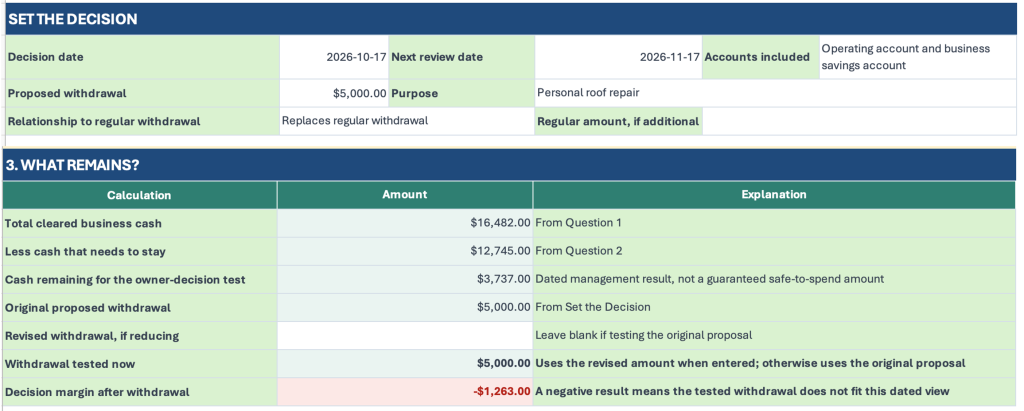
Completed Example: Nadia Tests a $5,000 Withdrawal
Nadia begins with $16,482 in cleared business cash. After identifying $12,745 that needs to remain in the business, the worksheet calculates a dated owner-decision amount of $3,737.
The book and worksheet do different jobs
| Book | Companion worksheet |
|---|---|
| Explains why the bank balance is not the withdrawal answer. | Provides the prepared one-page structure for a specific proposed withdrawal. |
| Explains what belongs in each cash job, what evidence supports it and where judgment is required. | Prompts the reader to enter current supported amounts and keep their status visible. |
| Shows how Nadia tests, reduces and records her proposed withdrawal. | Calculates the cash remaining and decision margin from the amounts entered. |
| Explains when the simple check is no longer enough. | Records the decision, reason, next action and next review. |
What This Book Does Not Determine
The book provides general educational information. It does not determine:
- whether GST/HST or QST applies to a transaction;
- whether an input tax credit or other tax treatment is available;
- how much income tax, CPP/QPP, GST/HST, QST or another amount is owing;
- how much cash should be protected as a planning reserve;
- whether a cost is deductible or how a transaction should be reported;
- which commitments or management limits fit a particular business; or
- how much cash a business can safely spend or an owner can withdraw.
PROFESSIONAL BOUNDARY: Tax, accounting, legal and financial conclusions may depend on current law, complete facts and professional judgment.
About the Author
Larry Cooper has more than 40 years of project and program leadership experience and has operated consulting and other small businesses since 1997. He writes as an experienced business owner, consultant and educator, not as a Chartered Professional Accountant, lawyer, bookkeeper or tax practitioner.
He created Built to Thrive to help Canadian small-business owners understand complicated systems, trace information and money, and add enough structure to reduce friction without unnecessary administration.
FAQs
- Does the book tell me exactly how much I can withdraw?
No. It shows how to organize one dated decision using cleared business cash, tax-related cash being protected, payments due before the next review, an operating buffer and unresolved items. It does not establish a universally safe withdrawal amount. - Does this replace bookkeeping?
No. The cash-jobs view depends on records that are current enough to support its inputs. It is a decision layer, not a complete bookkeeping system. - Does it calculate GST/HST or income tax?
No. It uses current records, filed amounts or planning estimates as inputs. It does not prepare a return or calculate the owner’s final tax liability. - Is this the same as the Canadian Sole Proprietor’s Field Guide?
No. That Money Already Has a Job solves one immediate cash-decision problem. The Field Guide teaches a broader operating system for recording transactions, completing the month, reading the financial picture and preparing the year-end handoff. - Is this book for corporations?
No. It is written for Canadian sole proprietors. Incorporated owner-managers need guidance that addresses salary, dividends, shareholder accounts and corporate obligations.
Do not let the bank balance make the decision for you.
Give the cash its jobs, test the proposed withdrawal and record what you decided before the money moves.
GET THE BOOK
Related Resource
For a broader recordkeeping and full-year operating system, see The Canadian Sole Proprietor’s Field Guide.