
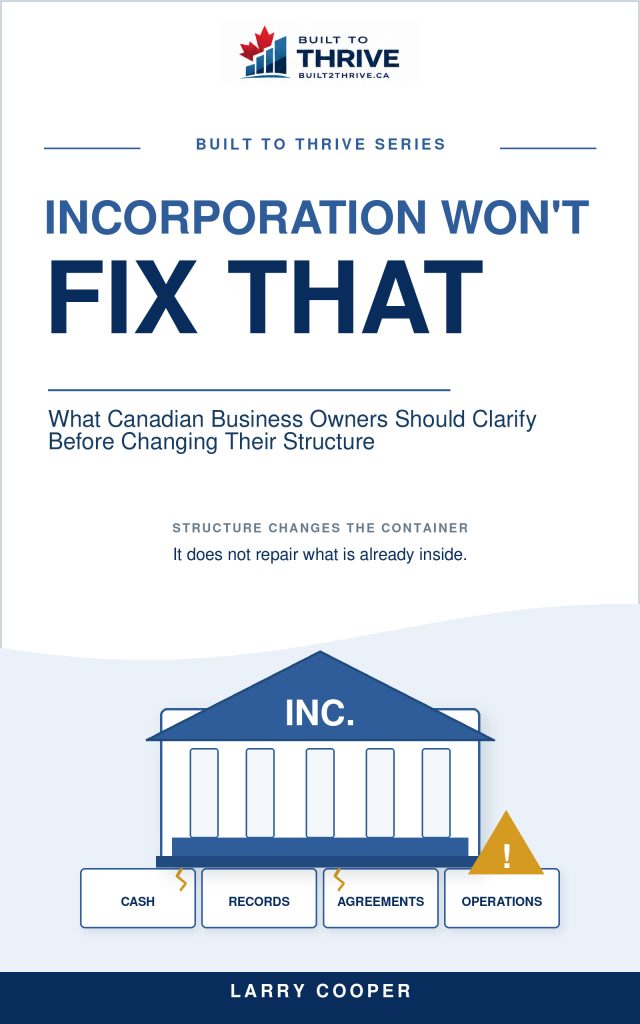
Incorporation Won’t Fix That
What Canadian Business Owners Should Clarify Before Changing Their Structure
Most incorporation services begin after you have decided to incorporate. This guide begins one step earlier: should incorporation be the answer at all?
It does not funnel you from a short questionnaire into forming a corporation. It helps you identify the problem you expect incorporation to solve and test that expectation against what a corporation actually changes.
Discover how to separate tax expectations, liability concerns, client requirements and growth plans from pricing problems, weak records, inconsistent cash flow and operating strain. See what incorporation changes, what it leaves untouched and what must be ready if you decide to proceed.
The result may be a clearer reason to incorporate, a reason to wait or a better set of questions to take to your accountant or lawyer.
Get the book
Incorporation Won’t Fix That is available as an eBook from participating retailers.
Not sure where to start? Take the Should I Incorporate? assessment
A corporation can solve a structure problem. It cannot repair the business for you.
Owners often hear that incorporation is the next step because the business is growing, a client asked about it, the work feels riskier or someone mentioned tax savings. Those may be valid reasons to investigate. They are not yet a complete decision.
The book helps the reader separate six questions that are often collapsed into one:
- Is incorporation required to reach a specific client, contract or market?
- What legal boundary would the corporation create, and what personal exposure could remain?
- Would any tax timing benefit still matter after the owner takes the cash needed personally?
- Is the business ready for separate records, filings, accounts, contracts and owner-payment rules?
- Which operating problems must be fixed regardless of structure?
- Which facts and implementation decisions require an accountant, lawyer or another qualified professional?
CENTRAL QUESTION: Does incorporation fit a clearly understood business need, and is the business ready to operate inside the corporate boundary?
A decision process, not a yes-or-no answer
- Name the event or problem making the decision timely.
- State the expected benefit in concrete terms.
- Gather evidence that supports or challenges that expectation.
- Separate operating problems incorporation will not repair.
- Identify the responsibilities and money boundaries a corporation adds.
- Compare the same business under both structures.
- Prepare a short fact package and targeted questions for professional review.
- Record the conclusion, next action and trigger for reassessment.
See the Decision Process in Practice
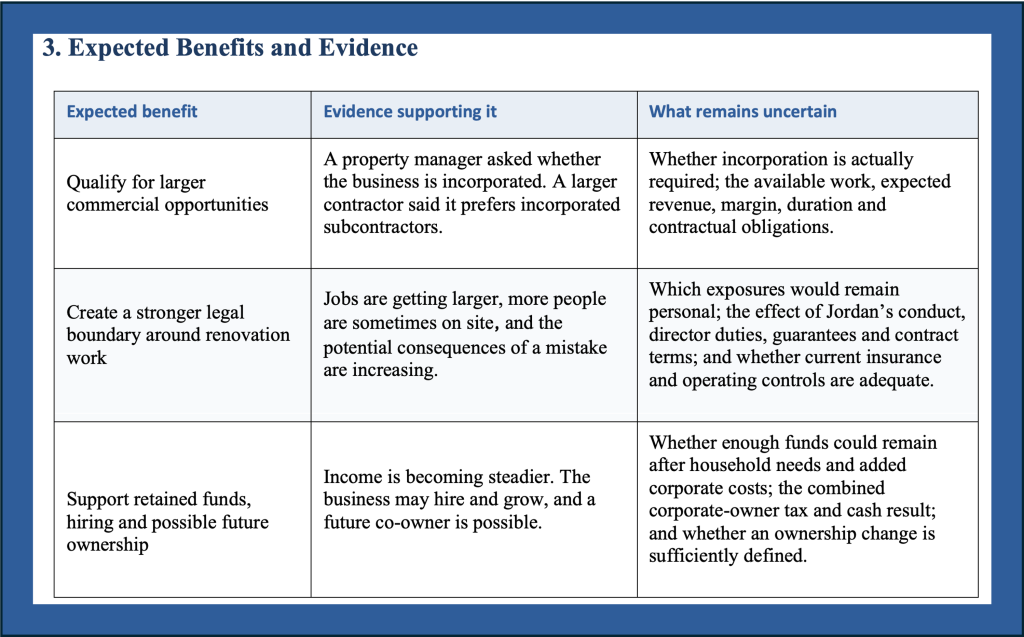
Jordan Patel runs a home-renovation business. Larger projects, possible customer expectations and increasing job-site risk have made incorporation worth examining.
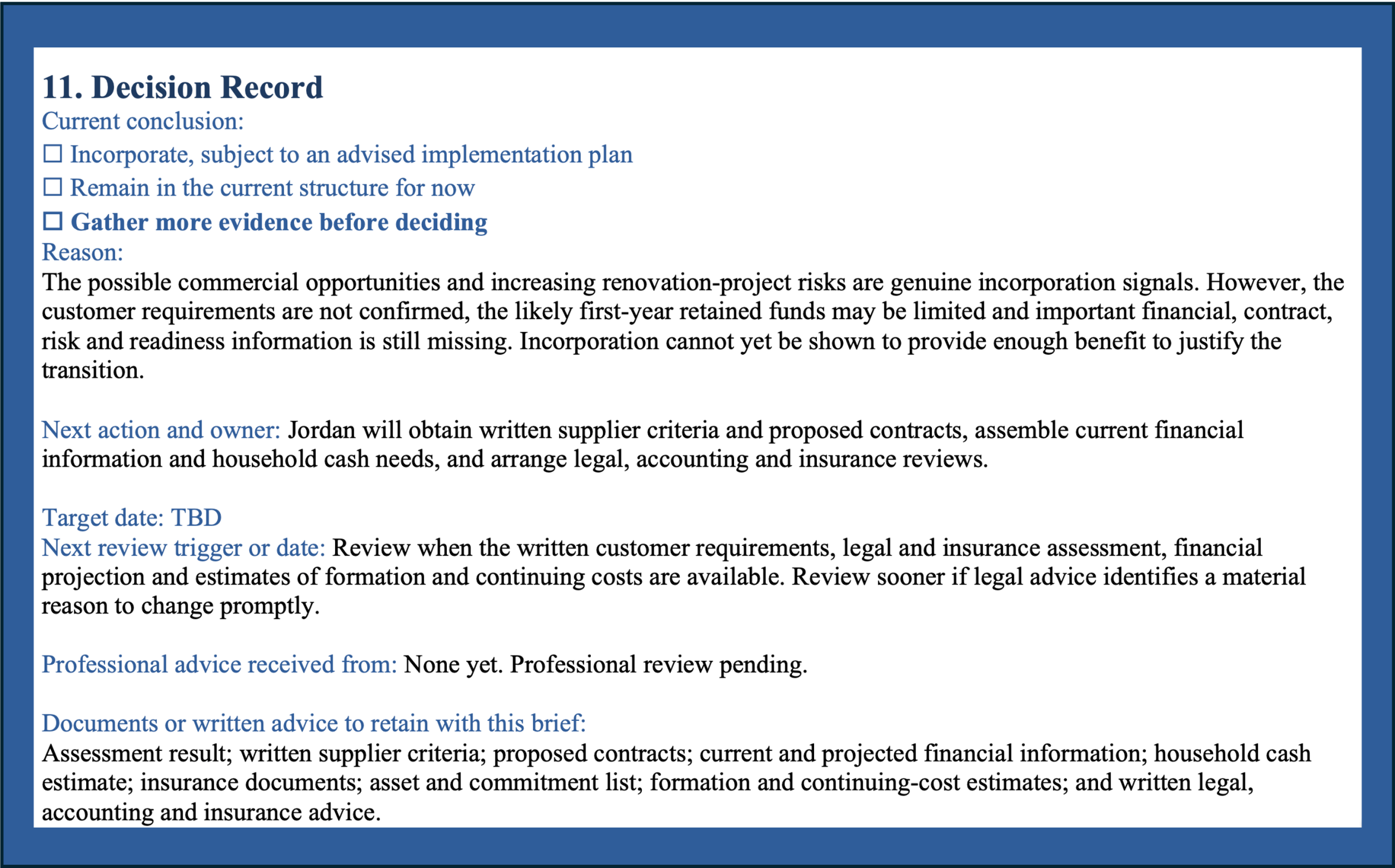
Jordan’s assessment result is Review Before Deciding. Instead of treating that result as a recommendation, Jordan uses the Incorporation Decision Brief to separate genuine incorporation signals from assumptions and unanswered questions.
1. Test the Expected Benefits
The optional Incorporation Decision Toolkit provides prepared worksheets for readers who want to document the process. It is sold separately and is not required to use the book.
What is inside the book
Jordan Patel’s home-renovation business carries one mixed incorporation decision through the book. Each chapter carries the same mixed decision from the initial assessment through clarification, comparison and preparation for professional review.
| Section | Reader outcome |
|---|---|
| Introduction: Start With the Assessment, Not the Answer | Use the assessment result to identify the separate commercial, risk, tax, ownership and readiness questions behind the decision. |
| Chapter 1: Understand What Your Result Is Telling You | Turn the strongest assessment signals into specific decision statements supported by evidence. |
| Chapter 2: Separate What Incorporation Changes From What It Will Not Fix | Understand the corporate boundary while identifying records, pricing, cash, contracts and operating problems that still require improvement. |
| Chapter 3: Test the Fit and Your Readiness | Compare the same business under both structures, identify readiness gaps and keep realistic alternatives visible. |
| Chapter 4: Prepare the Decision for Professional Review | Assemble the relevant facts, assign questions to the appropriate professionals and record the current conclusion and review trigger. |
| Conclusion: Make the Structure Serve the Business | Proceed, close readiness gaps or stay simple for now based on the evidence and professional review. |
Who this book is for
This book is designed for Canadian business owners who:
- are being told incorporation is the obvious next step;
- have a client, platform, lender or contract raising a structure question;
- are concerned about risk, liability, growth, ownership or continuity;
- expect tax savings but have not tested the expectation against personal cash needs;
- want to understand the added records and administration before committing; or
- want a better-prepared conversation with an accountant or lawyer.
Start with the assessment, then use the book to investigate the result
The Should I Incorporate? assessment organizes the initial signals into one of three starting points: Stay Simple for Now, Review Before Deciding or Strong Incorporation Signals. The result is not a recommendation. The book helps the owner understand why that result appeared, which factor deserves more attention and what evidence is still missing.
Optional companion toolkit
The attached materials support the same decision process. The book remains usable on its own.
| Download | What it helps the reader do |
| Save Your Should I Incorporate? Result | Keep the assessment result, the answers that influenced it, one significant factor and a trigger for reassessment. |
| What You Need to Separate Early: Owner, Business, and Money | Identify separation habits worth building whether the owner remains a sole proprietor or incorporates later. |
| Problems Incorporation Will Not Repair | Find weaknesses in records, financial visibility, pricing, cash flow, agreements and owner-dependent operations. |
| Sole Proprietor or Corporation: What the Choice Really Changes | Compare legal identity, tax filing, owner payments, administration, ownership and continuity without treating either structure as the automatic upgrade. |
| Questions to Bring to Your Accountant or Lawyer | Prepare questions matched to the assessment result and the professional decision that needs to be made. |
| Incorporation Decision Brief | Bring the assessment, expected benefits, evidence, readiness gaps, financial facts, alternatives and professional questions into one decision record. |
The book and toolkit do different jobs
| Book | Companion toolkit |
| Explains what incorporation changes and what it cannot repair. | Captures the reader’s facts, gaps, comparisons and questions. |
| Uses Jordan’s business to model the full decision process. | Gives the reader ready-made checklists, comparison tables and a decision brief. |
| Shows where professional judgment and implementation are required. | Helps the reader prepare a more organized professional conversation. |
| Can be used without downloading another resource. | Provides optional structure for readers who prefer prepared pages. |
What this book does not determine
The book provides general educational information. It does not determine:
- whether the reader should incorporate;
- whether federal, provincial or territorial incorporation is appropriate;
- the jurisdiction, name, articles, share classes, ownership or governance structure;
- whether incorporation will reduce tax in the reader’s circumstances;
- how salary, dividends, reimbursements, shareholder loans or benefits should be treated;
- the legal responsibility of the corporation, shareholder, director, officer or another person;
- whether or how assets, contracts, permits, employees, debts or tax accounts should be transferred; or
- the tax, legal, accounting, insurance, financing or administrative systems the business requires.
PROFESSIONAL BOUNDARY: Those conclusions may depend on current law, the incorporating jurisdiction, complete facts and professional judgment.
About the Author
Larry Cooper has spent more than 40 years in project and program leadership across public and private sector organizations. In 1997, he started his own consulting business, and has run other small businesses since — including a boutique corporate education firm. Larry is not a Chartered Professional Accountant (CPA), lawyer, bookkeeper, or tax practitioner. He writes as an experienced business owner, consultant, and educator.
He created Built to Thrive to help Canadian small-business owners build stronger foundations and participate more effectively in important business and professional discussions.
FAQs
- Does this book tell me whether I should incorporate?
No. It helps you clarify the problem, test the expected benefit, identify readiness gaps and prepare for professional review. It does not recommend a structure. - Is this a do-it-yourself incorporation guide?
No. It does not select a jurisdiction, articles, shares, ownership, governance or a tax implementation plan. - Does incorporation automatically reduce tax?
No. The outcome depends on the business and owner’s facts, including profit, personal cash needs, payment method and current tax rules. A qualified accountant or tax advisor should assess the numbers. - Does a corporation eliminate personal liability?
No. A corporation creates a separate legal boundary, but guarantees, director obligations, personal conduct and other facts can still create personal exposure. A qualified lawyer and insurance professional should review the specific risks. - Do I need to complete the assessment first?
It is the recommended starting point because it records the signals influencing the decision. The book can still be read without it. - Are the companion downloads required?
No. They are optional implementation aids. The Incorporation Decision Brief is also reproduced in the book. - Is this only for sole proprietors?
It is primarily for owners considering a move from a sole proprietorship or another current arrangement to a corporation. The decision still requires jurisdiction-specific and fact-specific professional review.
Make the structure serve the business.
Clarify the business need, test what incorporation would actually change and prepare the right facts and questions before changing the structure.
GET THE BOOK
TAKE THE ASSESSMENT