
Sole Proprietor Guides
Build clearer records and financial routines without making the business unnecessarily complicated.
Use this path when your business is not incorporated and you report its income and expenses on your personal tax return.
These guides help you organize records, track expenses, understand GST/HST, build a monthly review routine, and prepare for tax filing and year-end with fewer surprises.
Start with the layer that matches the work in front of you. You do not need to begin at Awareness or complete every guide in order.
Awareness guides are free to read. Practice and Maturity guides require a Starter Account. Advanced guides require Advanced Access. Access to matching checklists, trackers and workbooks is shown separately on each guide and tool page.
Start with the layer that best matches where you are right now and follow a simple action plan.
1. Establish the Basics — Awareness
Start here when records are scattered, business and personal activity are still mixed, or you are unsure what should be tracked from the beginning.
These guides help you create visibility, separation, and a simple record-keeping foundation before financial activity becomes harder to organize.
What to Do in Your First 30 Minutes
Start with visibility rather than perfection. Identify what already exists, separate business activity from personal activity, and create one reliable place for financial records.
Matching tools: Starter Checklist
How to Set Up Record-keeping Without Overthinking It
Create a simple system for receipts, statements, tax documents, and supporting records that remains usable as the business grows.
Matching tools: File Naming & Record Storage Guide
What Financial Habits Matter in Your First 90 Days as a Sole Proprietor?
Build a small number of financial habits early so records, obligations, and business activity are easier to track and explain.
Matching tools: Basic Financial Habits Tracker • First 90-Days Priorities Checklist
2. Build Regular Financial Habits — Practice
Use these guides when business money is already moving and you need consistent habits for expenses, records, GST/HST, and monthly review.
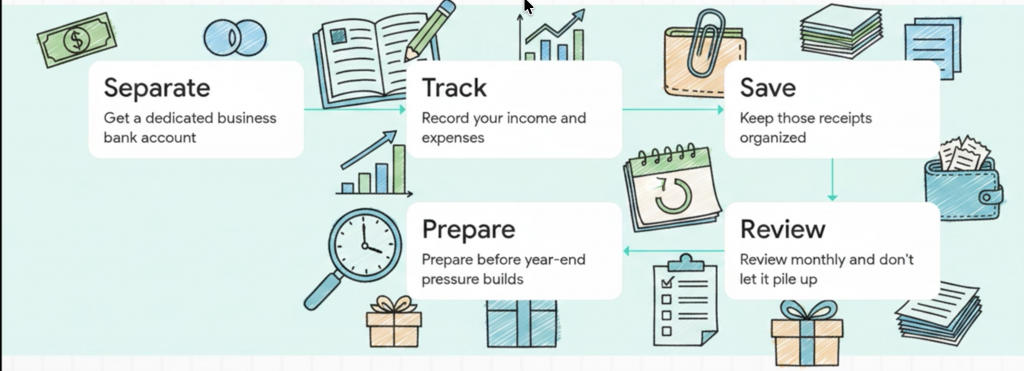
The goal is a financial routine that stays current throughout the year instead of requiring a major cleanup near tax time.
How to Track Expenses Without Making It Complicated
Create a practical expense-tracking habit that keeps receipts, categories, and business spending organized from month to month.
Matching tools: Sole Proprietor Expense Categories Reference • Sole Proprietor Expense Tracker Workbook
Your Monthly Money Routine
Use one monthly review to update records, check cash movement, review obligations, and identify missing information before it becomes a larger problem.
Matching tools: Monthly Review Checklist
How to Know When GST/HST Is Starting to Matter
Understand when GST/HST registration may apply, how the $30,000 small-supplier threshold works, and what should be monitored before registration becomes urgent.
Matching tools: GST/HST Threshold Checker • GST/HST Awareness Worksheet
3. Strengthen the Financial System — Maturity
Use these guides when basic tracking is no longer enough and you need stronger visibility, more complete records, or better preparation for tax filing and year-end.
The goal is not simply to record transactions. It is to use a financial system that helps you understand what is happening and prepare before deadlines create pressure.
When a Simple Tracker Stops Being Enough
Recognize when basic tracking no longer provides enough detail, control, or year-end support and when a fuller workbook may be more appropriate.
Matching tools: Full Sole Proprietor Workbook • Full Sole Proprietor Workbook Guide
Understand Your Numbers and Use Them
Review income, expenses, cash movement, and financial patterns so the records support decisions rather than existing only for tax filing.
Matching tools: Financial Interpretation Prompts
Prepare for Year-End Before It Arrives
Build enough structure during the year that tax obligations, supporting documents, open questions, and year-end records are easier to manage.
Matching tools: Year-end Readiness Checklist – Sole Proprietor
4. Review More Complex Issues — Advanced Library
Some sole proprietor financial issues require more than a basic checklist, tracker, or monthly routine.
Use the Advanced Library when expense claims, GST/HST, owner withdrawals, year-end review, or the limits of your current tracking system require closer attention.
These guides help you understand the issue, organize the relevant information, and prepare stronger questions before speaking with an accountant, bookkeeper, or tax adviser.
Advanced topics include:
- when sole proprietor tracking is no longer enough;
- advanced expense review for home office, vehicle, meals, tools, and equipment;
- GST/HST issues that become expensive later;
- year-end review before filing as a sole proprietor;
- owner draws and cash-available planning.
Advanced Access required
Not Sure Where to Start?
- If records are scattered or you are just beginning, start with What to Do in Your First 30 Minutes.
- If income and expenses are already moving, start with Your Monthly Money Routine.
- If GST/HST may soon apply, start with How to Know When GST/HST Is Starting to Matter.
- If your current spreadsheet is becoming difficult to manage, start with When a Simple Tracker Stops Being Enough.
- If tax filing or year-end is creating pressure, start with Prepare for Year-End Before It Arrives.
- If the issue has become more complex or higher consequence, use the Sole Proprietor Advanced Library.
Helpful Explainers
Use these short explainers when a financial concept needs more context. Individual guides will also direct you to the most relevant explainer.
| Explainer | Use it when… |
|---|---|
| Why Separating Business and Personal Activity Matters | Business and personal money, purchases, accounts, or records are becoming mixed. |
| What Records Should You Keep From Day One? | You need to know which receipts, statements, invoices, and supporting documents should be retained. |
| What Counts as a Business Expense? | You are unsure whether a cost belongs in the business records. |
| What CRA Means by a Reasonable Expense | You need to consider whether an expense is supportable and connected to earning business income. |
| Current vs. Capital Expenses Explained | You purchased equipment, tools, computers, furniture, or another longer-term asset. |
| Cash Flow vs. Profit | The business appears profitable but available cash tells a different story. |
| Understanding Your Income Statement and Financial Position | You want to understand what income, expenses, profit, assets, liabilities, and financial position are showing you. |
| When the $30,000 GST/HST Threshold Starts to Matter | Revenue is approaching the small-supplier threshold or registration may soon be required. |
| Why GST/HST Collected Is Not Your Money | GST/HST is being mixed with ordinary operating cash. |
| Input Tax Credits Explained | You need to understand how eligible GST/HST paid on business purchases may reduce the net tax you remit. |
| GST/HST Filing Frequency Explained | You need to understand how annual, quarterly, or monthly filing periods affect reporting and payment timing. |
| Owner Draws vs. Reimbursements | You take money from the business or personally pay business costs. |
| When a Spreadsheet Is Enough—and When It Is Not | You are deciding whether basic tracking still fits or a fuller system is needed. |
Educational Note
Built to Thrive is educational only. It does not provide legal, tax, accounting, bookkeeping, payroll, GST/HST, investment, filing, software, or business advice.
Your tax obligations, GST/HST status, expense treatment, instalment requirements, year-end preparation, and choice of financial system depend on your circumstances. Consult an appropriate qualified professional before making significant decisions.